
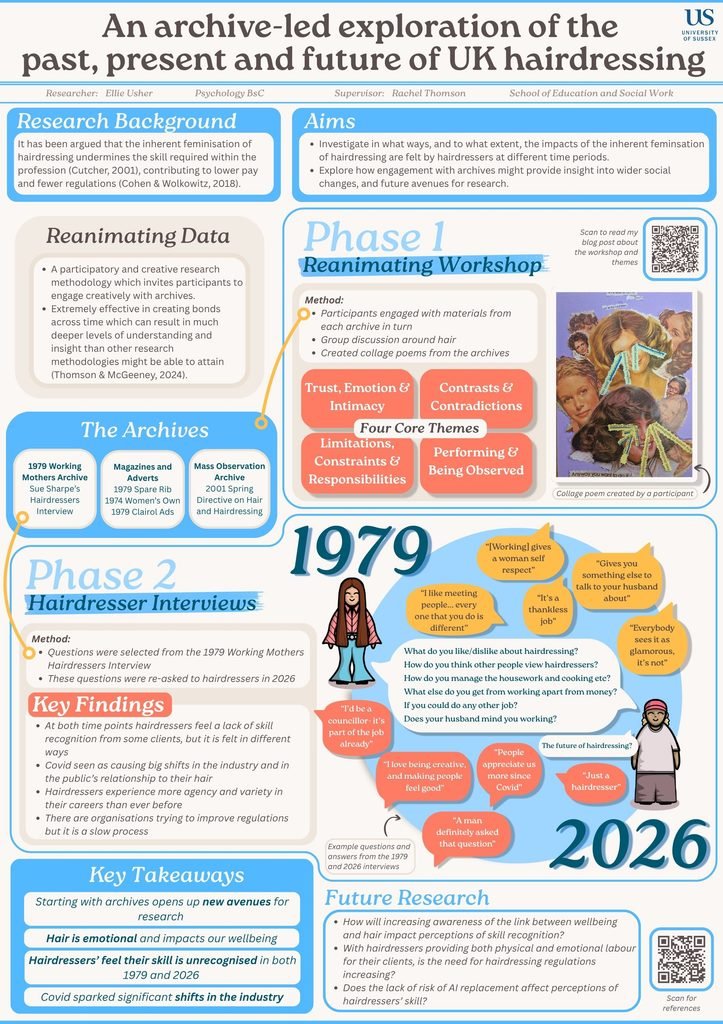
Last Summer, undergraduate psychology student Ellie Usher created this poster to share the research they have been doing with hairdressers using archived material. Here are Ellie’s reflections on phase 2 of their project, where they interviewed modern-day hairdressers using questions from an interview conducted by independent researcher Sue Sharpe over 40 years ago.
Next best thing
The idea to interview modern-day hairdressers using Sue Sharpe’s 1979 interview questions came about quickly and was not the original plan. Rachel Thomson and I were aiming to run a follow-up workshop to one conducted a few months before, however finding hairdressers to take part had proved impossible in late July. Given the limited timeframe, by the time I found out that August was generally a quiet month for hairdressers it wasn’t feasible to organise a workshop. So, with reanimating methods in mind, I set about trying to come up with a next-best thing.
Re-asking
Having spent a long time transcribing Sue’s original interview with hairdressers in 1979, I was intimately familiar with the content and had been noting the moments that stood out to me because they placed the interview in a different time. From here I began constructing an interview schedule using some of the questions Sue had asked, and some statements the 1979 hairdressers had made. Some of the questions were to get some context: “how many people work here”, “how long have you been hairdressing”, while others were about experiences and attitudes: “what is it you like about hairdressing”, “what would you do if you could do any other job”. Then there were the three questions I had highlighted as placing Sue’s interview firmly in the past, each of which I was a little anxious about asking: “What do you think about mothers working?”, “How do you manage the cooking and cleaning?”, “Does your husband mind you working?”.
Times have changed
The hairdressers I interviewed knew that the questions came from an interview from 1979, and I told them that the latter 3 questions were not ones I would ask today and I was also interested in hearing their thoughts on the questions themselves. However in hindsight, I think part of me felt uncomfortable taking Sue’s questions out of context without giving enough time to delve into the questions in depth. Sue asked these questions in earnest, in a conversation almost 50 years ago, and were perfectly understandable and normal things to question at the time. Yet, in 2026, asking these questions prompted cackling laughter from my hairdressers, and responses like “WOW” and “a man definitely asked that”. In one interview I asked the hairdresser why they thought these questions were funny and the reply I received was that “you just can’t ask these questions anymore, times have changed”. Which is absolutely true, but I really wished we had more time, or a better setting to explore what this really means.
In need of more time (binds)
The context for these interviews was that I had arranged to meet the hairdressers at their salons in the middle of the work day, so I was conscious to not take up too much of their time. This meant that I was limited in the amount of following-up I could do if we were to get through all of the questions – particularly in one salon where a group of 4 hairdressers were present, each of whom I wanted to give time to comment on each question. I think that presenting Sue’s questions in this format and within this timeframe (verses in a workshop for example) limited the amount of exploration and analysis my participants could engage in. The insights I gained were undoubtedly valuable, but I do wonder what else we could have discovered if the time bind (ie. the empathy and connections I felt toward the 1979 hairdressers) was also experienced by the 2026 hairdressers.
A thankless job
There was one particular revelation which had a significant impact on me from my position of insight into past and present. In 1979 Sue asked the hairdressers if there were any trade unions in hairdressing, to which the hairdressers responded “no”, and that ‘if they were to go on strike none of their clients would come back’. This epitomised something they had been expressing at times throughout the interview – that they felt underappreciated by their clients, describing hairdressing as a “thankless job”. I didn’t ask the hairdressers in 2026 about trade unions, but when asked about what they disliked about their job this same feeling of underappreciation was mentioned, especially in regard to some older clients who the hairdressers felt see them as “just a hairdresser”. However, across both 2026 salons I interviewed, Covid was brought up as a trigger which dramatically altered client perceptions of the hairdressers. They believed that for many clients, being unable to visit their hairdresser during lockdown had forced them to recognise the impact that hair has on their mental health and wellbeing, which resulted in an increased appreciation for their hairdressers. This discovery really made me feel all warm and fuzzy for the hairdressers today, especially given the fact that hairdressing continues to be a female-dominated industry characterised by long hours, limited regulations, extensive emotional labour and low pay: hairdressers deserve appreciation! Maybe Covid could be a catalyst for positive change? But this discovery equally left me with an uncomfortable feeling of sadness and frustration that I couldn’t let Sue’s hairdressers know that their imagined expectations of client reactions to the absence of their hairdressers could not have been further from the truth.
What else might a hairdresser-hairdresser time bind reveal?
Something I didn’t quite recognise at the time, was that by taking Sue’s questions out of context, the differences over time were exaggerated to my participants. While identifying the differences over time was something I set out to explore through these interviews, with hindsight I believe that not grounding Sue’s questions in the context of the interaction they originally occurred in (ie. by failing to relay the answers or describe the experiences of the 1979 hairdressers), the 2026 hairdressers’ ability to explore deeper meaning was limited, and connections over time were prevented from forming. Identifying differences over time can help to gain insight into change, but establishing connections can give way to deeper meaning and understanding. These interviews undoubtedly gave me lots to analyse, but I can’t help wondering what else a hairdresser-hairdresser time bind might reveal.