
Ellie Usher
A few weeks ago, while the South of England was melting in the latest heatwave, I was lucky enough to accompany Rachel Thomson and Ellie Turner-Kilburn to the comparatively temperate streets of Edinburgh. We had been invited by Niamh Moore and Martina Karels to host a reanimating workshop at the University of Edinburgh’s Institute for Advanced Studies in the Humanities.
This was a perfect opportunity for us to explore the dataset Rachel and I are working with this summer: one of Sue Sharpe’s 1979 working mothers interviews conducted with a group of hairdressers for her book Double Identity: the lives of Working Mothers. We plan to bring this interview to a group of contemporary hairdressers later this summer to see what insights we might gain from their perspectives, and how they might vary from the group of academics who attended this workshop in Edinburgh.
The workshop began with Rachel introducing the dataset and the socio-political context of the time. As an ice-breaker, each participant had been invited to bring an image of a hairstyle they’d had in the past, or one they would like in the future, and we took turns sharing our images and what they meant to us. It became clear very quickly that hair can mean completely different things to different people, and our relationship to hair and hairdressing can be an emotional one.
Some within the group focused on the physical characteristics of hair, how natural growth patterns or texture can prevent our hair from achieving our idealised vision, or how hormonal changes to hair can be a painful reminder of traumatic experiences. Others drew attention to the experience of hairdressers and the hairdressing space, with some feeling a close bond and attachment to their hairdresser, and others completely averse to any spaces resembling a salon. A few participants noted that in their experience hair was a tool for self-expression while others had experienced a loss of identity when hairstyles ‘weren’t them’.
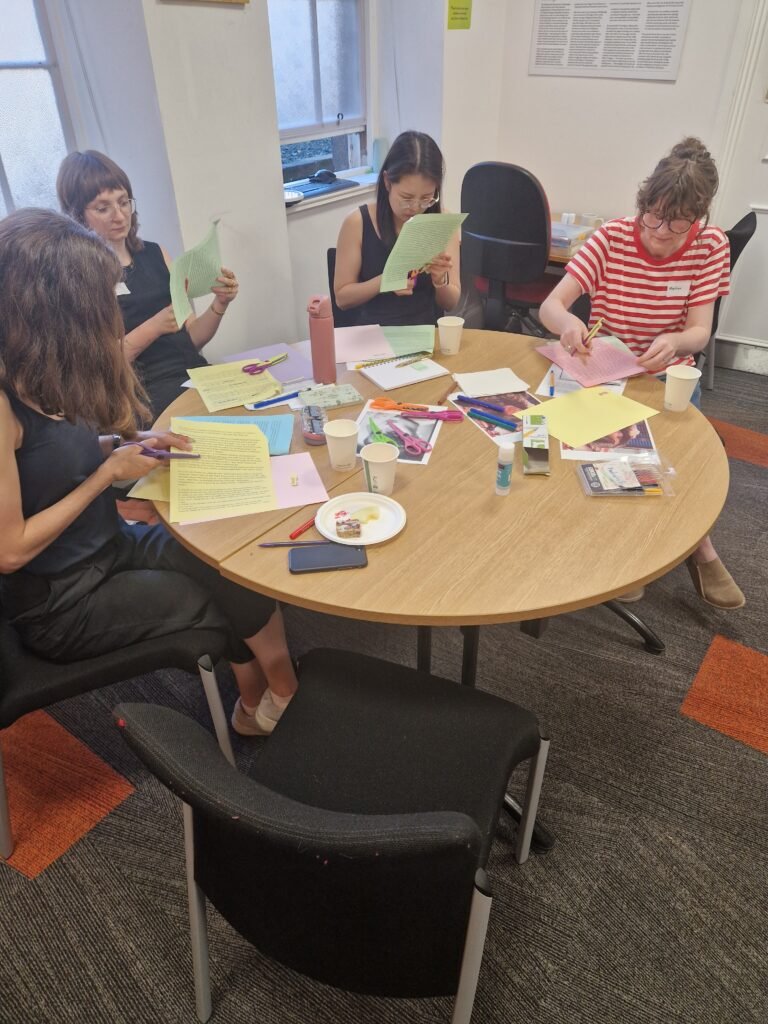
Throughout the workshop, participants engaged with Rachel’s summary of the interview, listening as Rachel read it aloud and underlining as they followed along. They were introduced to material from the Mass Observation Archive on hair and hairdressing, and were provided with copies of text and imagery from 1970s Spare Rib and 1970s Clairol home haircare adverts. From these materials, participants were invited to construct poems from the text, and create a collage. Throughout the session the group sat in quiet concentration, with the sound of scissors creating an unintentional hairdresser-themed soundscape as they worked.
Each participant named their collage before presenting it, and discussing the elements they were drawn to with the group. Below is my a summary of some themes which seemed to run through the session as a whole, reflected not only in the final collages created by the participants, but in discussions throughout the session.
Limitations, Constraints and Responsibilities
It was noted by some that the women in the 1979 interview seemed to be focused on the limitations and constraints of their circumstances, as well as the responsibilities they had which included looking after children, working conditions, legal and social expectations and rules, needing to ‘keep your hand in’ the profession, their financial situation and returning to work through necessity not choice. Yet curiously, limitations also seemed to be a key theme for our participants in relation to their own hair, with discussions involving physical attributes such as texture and growth patterns limiting their ability to achieve their dream hair, health, medicine and hormonal changes limiting the way hair physically grows, being limited by their hairdresser’s own desires to cut their hair how he would like rather than what they have asked for.
One collage which focused on the feeling of constraint and limitation was titled “Too Late” and captured a feeling of time anxiety felt both by the creator in terms of being limited in time to make their collage, and in the words of the 1979 hairdressers in relation to their circumstances.
I have found myself wondering to what extent the focus on personal limitations within this workshop might have come from a general awareness of the topic itself, since the hair and beauty space is one which traditionally compares and shames women by encouraging them to focus on their ‘problems’ or ‘shortcomings’.
In terms of the hairdressers, there is a sense of them trying to convey that they are good mothers who are limited by their circumstances with most of them admitting they would prefer not to be working but need the money. Since continuing to work after becoming a mother was shamed to an even greater extent in the 1970s than it is now, it comes across in the interview that these women feel it is important to convey that they are a victim of their circumstance, and not that they have ‘left their children’ by choice.
Performing and Being Observed
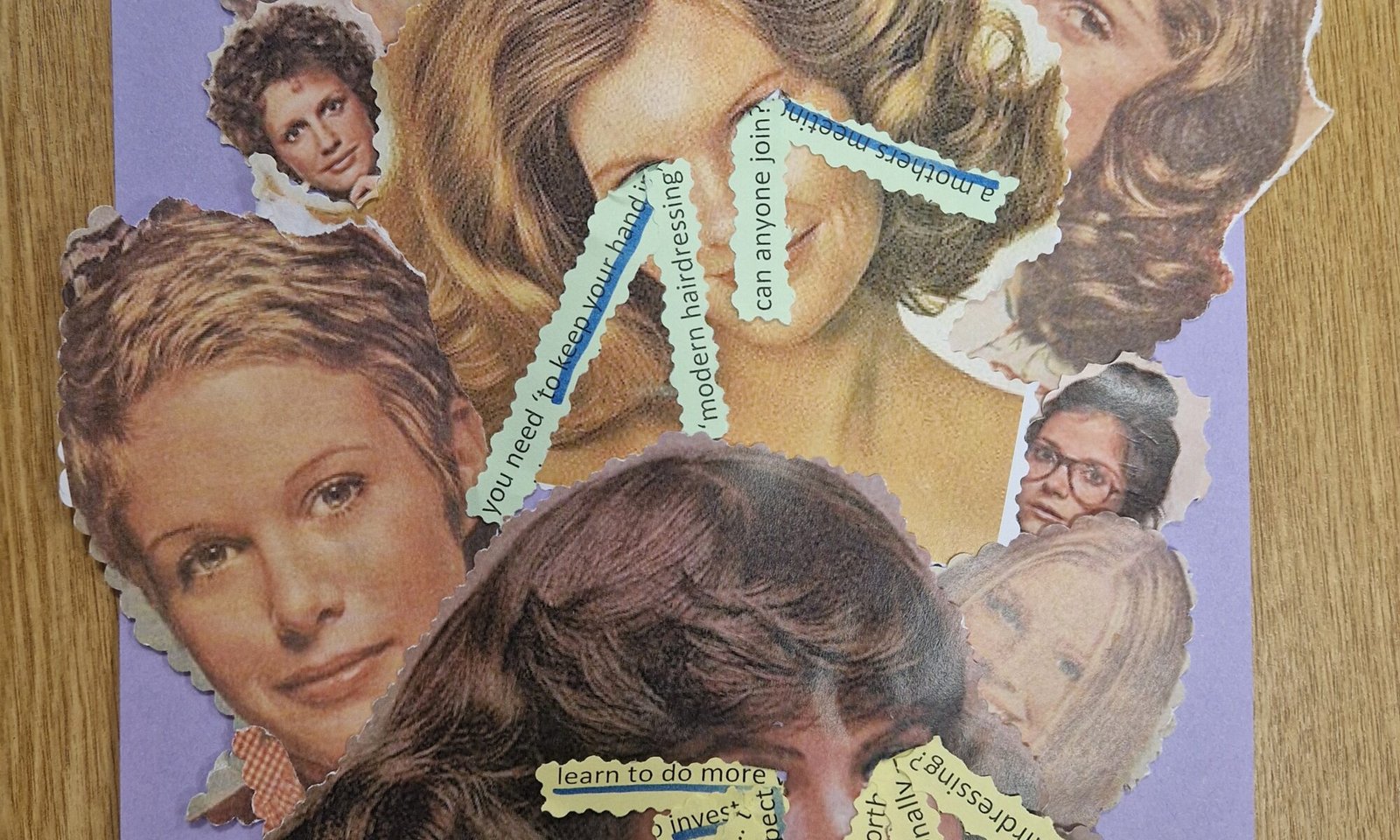
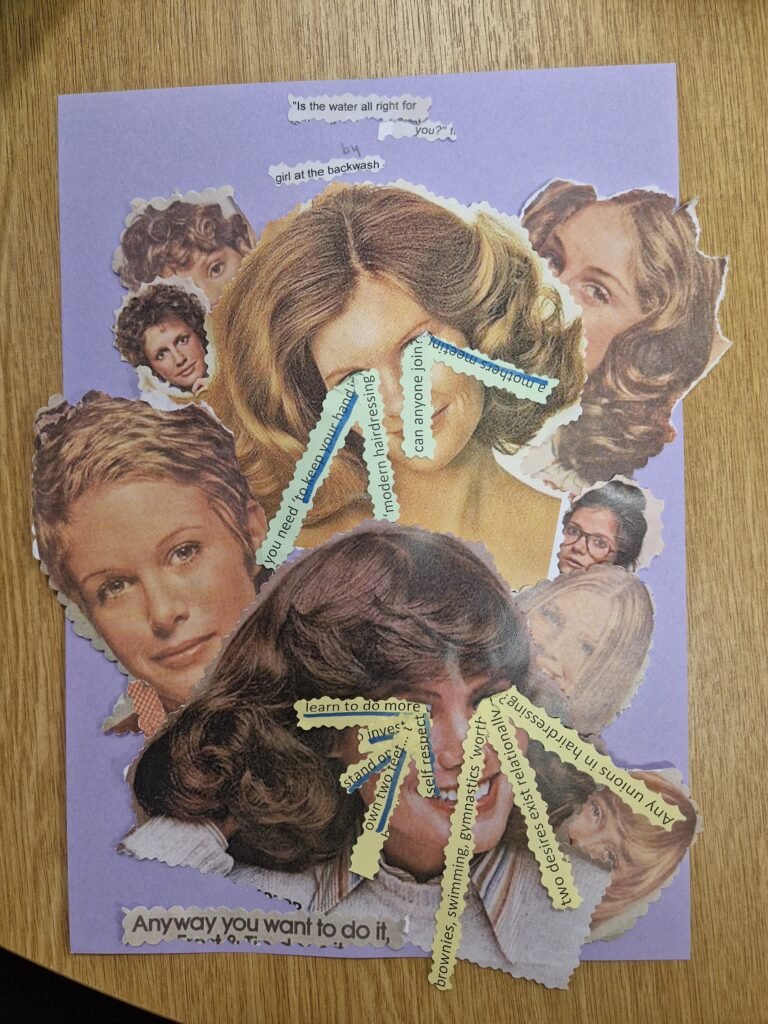
Another common thread raised during the workshop was a sense of performing, and an awareness of being observed. This was noted by several participants who acknowledged comments in the interview such as the notion of being ‘on display’ as a woman, feeling a need to look presentable for the salon, not wanting to be perceived as ‘lazy’, and interpreting the hairdressers words as a performance of independence, happiness and choice. One collage named “’Is the water all right for you?’ by Girl at the backwash” focused heavily on being observed and observing others in return. It features many faces staring back at you, some with phrases such as “modern hairdressing” and “you need to keep your hand in” spilling out of the eyes to capture the feeling of being on display.
This was a feeling mentioned by many in the group and so I began to wonder who the women in the interview might have felt they are performing for and being observed by; it could be the pressures of maintaining a certain image in an appearance-focussed working environment, or it could be the interviewer, Sue, who asks many personal questions about being working mothers, or it might be more of a reflection of society at the time and how they feel the judgement of others in wider society. I would imagine all three play a role.
Being observed was another element that was raised when discussing participant’s own hair: our hair tells a story, it is an embodiment of our personality and communicates a lot to others. We also make assumptions about people depending on their hair- something which is so well-established that one third of the prompts given to the respondents of the Mass Observation Archive on hair referenced judging others on their hairstyle and colour. I would suggest that hair could be considered a tool for social communication, and therefore it might be inevitable that an awareness of being observed would arise from this topic.
Contrasts and Contradictions
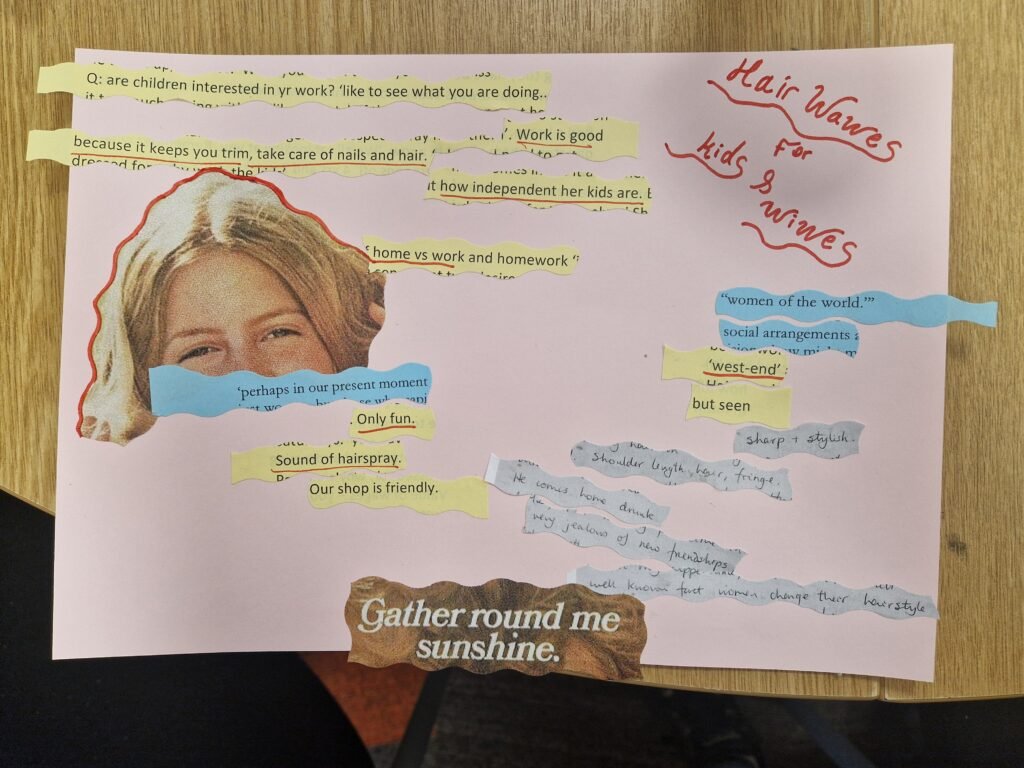
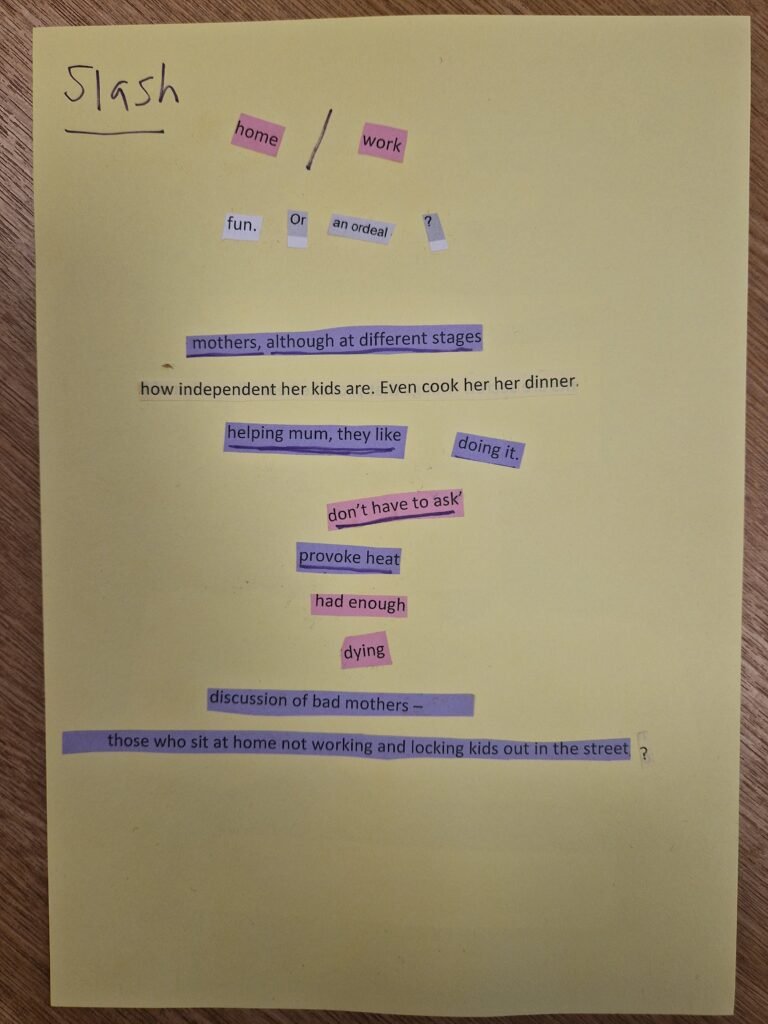
Contrasting opinions, feelings and experiences ran through this session from the start, as I described earlier in terms of the ice-breaker. But many of the collages seemed to also capture the feeling of contrasts or multiple opinions at once. One collage titled “Hair waves for kids and wives” voiced what the children’s experiences of the salon might have been in contrast to their mothers’. The creator mentioned the ‘precarity of hairdressing versus the optimism of childhood’. Another collage titled “Slash” questioned whether the hairdressers’ situations in relation to home/work were ‘fun or an ordeal’. In general the group seemed to be picking up on some contradictions in what the hairdressers were saying in the ways they were portraying their experiences – with the biggest surprise being that despite hair being the focal point of their work, at no point did they mention hair. The focus on contrasts and contradictions may have also been a reflection of a group awareness of the variety of experiences in the room or even a reflection of the varied tone and content in the materials we gave them to work with.
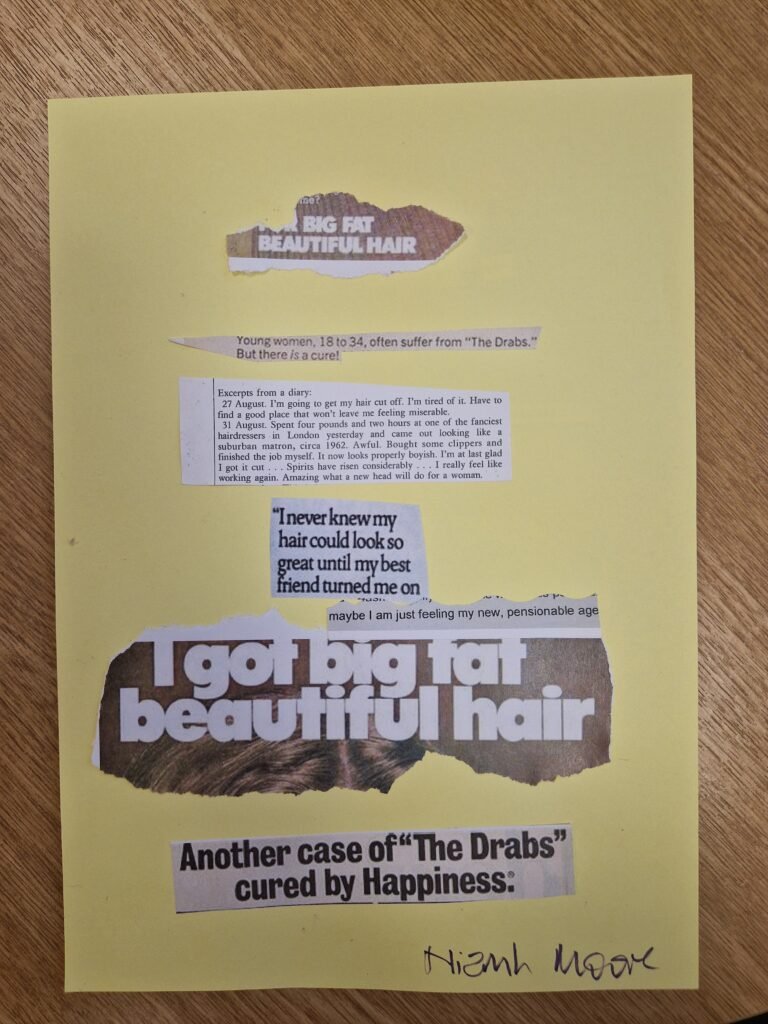
One further contradiction came in the form of subverting the expectations of beauty as projected by the 1970’s Clairol adverts, as one member of the group declared that short and clippered hair can be “big fat and beautiful”.
Trust and Intimacy
Notions of intimacy and trust between the hairdressers themselves were acknowledged by the group in terms of the women helping each other through tough circumstances, and banding together in the face of adversity and hardship: one participant became interested in when the “I’s” turned into “we’s” in the hairdressers’ stories.
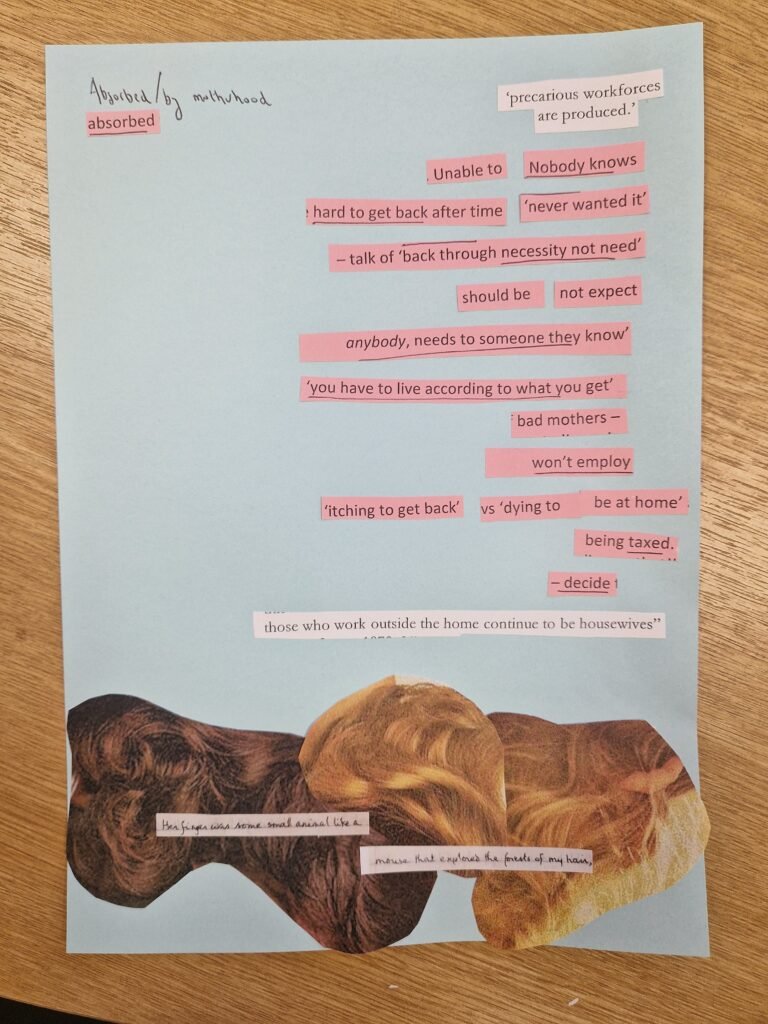
But hair can be a personally intimate topic and this was noted in the group’s discussions. One collage titled “Absorbed” centred on motherhood and the memories held in hair and touch. It is clear from the Mass Observation Archive alone that mothers are generally and historically the primary carers for children’s hair, until they reach an age at which they wish to outsource the job to a professional. Once we start outsourcing this very intimate job to someone outside of the family, we look for someone we can trust.
This was mentioned in the context of finding and holding onto a hairdresser for life or feeling lost when a beloved hairdresser moves or retires. Several participants explained that they would go without a haircut, or would cut their own hair rather than trying a new hairdresser, to the point that one participant had almost forgotten other hairdressers existed!
This was my first experience of a reanimating workshop, and when looking back at the day I have found myself thinking about the ‘time bind’ (Freeman, 2010). Participants were several steps removed from the women in the 1979 interview since they did not hear or read the hairdressers own words, but instead accessed their stories via Rachel’s summary of the interview. Despite this, participants seemed to pick up on things which Rachel and I had not, and still seemed able to find some deeper insight into the experiences of these women who are so far removed from them, which seemed to me to end up being (however conscious or subconscious) reflected in their own experiences of hair.
Maybe it is the psychologist in me but everything about this process feels like it could (and maybe should?!) be a form of therapy. By connecting with the experiences of people in archived material, the time bind gives us the space to process our own feelings from a distance, whilst empathising with those we can’t and never will know. In my opinion, we can never truly know the reality of the past, since we construct it through our own perspective based on our present-day experiences. However, this very fact means that this method provides us with incredibly rich insight into experiences of the present. The beauty of this topic is that hair, being so integral to our identity, means that everyone has an emotional connection to it. However, I am endlessly curious about how the contemporary hairdressers will approach this same material and what we might learn about the present and future from their interpretations.
Freeman E (2010) Time Binds: Queer Temporalities, Queer Histories. Durham, NC: Duke University Press.