“Is The Water Alright For You” by Girl at the Backwash

Ellie Usher 

A few weeks ago, while the South of England was melting in the latest heatwave, I was lucky enough to accompany Rachel Thomson and Ellie Turner-Kilburn to the comparatively temperate streets of Edinburgh. We had been invited by Niamh Moore and Martina Karels to host a reanimating workshop at the University of Edinburgh’s Institute for Advanced Studies in the Humanities.

This was a perfect opportunity for us to explore the dataset Rachel and I are working with this summer: one of Sue Sharpe’s 1979 working mothers interviews conducted with a group of hairdressers for her book Double Identity: the lives of Working Mothers. We plan to bring this interview to a group of contemporary hairdressers later this summer to see what insights we might gain from their perspectives, and how they might vary from the group of academics who attended this workshop in Edinburgh. 
The workshop began with Rachel introducing the dataset and the socio-political context of the time. As an ice-breaker, each participant had been invited to bring an image of a hairstyle they’d had in the past, or one they would like in the future, and we took turns sharing our images and what they meant to us. It became clear very quickly that hair can mean completely different things to different people, and our relationship to hair and hairdressing can be an emotional one.

Some within the group focused on the physical characteristics of hair, how natural growth patterns or texture can prevent our hair from achieving our idealised vision, or how hormonal changes to hair can be a painful reminder of traumatic experiences. Others drew attention to the experience of hairdressers and the hairdressing space, with some feeling a close bond and attachment to their hairdresser, and others completely averse to any spaces resembling a salon. A few participants noted that in their experience hair was a tool for self-expression while others had experienced a loss of identity when hairstyles ‘weren’t them’. 

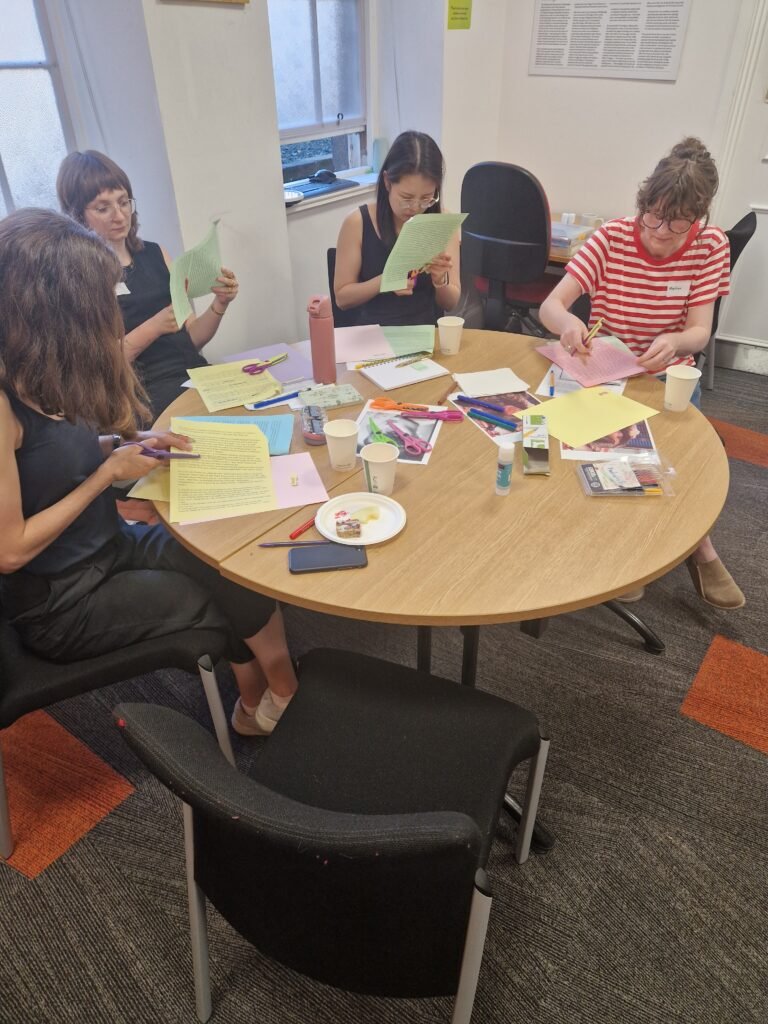
Throughout the workshop, participants engaged with Rachel’s summary of the interview, listening as Rachel read it aloud and underlining as they followed along. They were introduced to material from the Mass Observation Archive on hair and hairdressing, and were provided with copies of text and imagery from 1970s Spare Rib and 1970s Clairol home haircare adverts. From these materials, participants were invited to construct poems from the text, and create a collage. Throughout the session the group sat in quiet concentration, with the sound of scissors creating an unintentional hairdresser-themed soundscape as they worked. 

Each participant named their collage before presenting it, and discussing the elements they were drawn to with the group. Below is my a summary of some themes which seemed to run through the session as a whole, reflected not only in the final collages created by the participants, but in discussions throughout the session.

Limitations, Constraints and Responsibilities

It was noted by some that the women in the 1979 interview seemed to be focused on the limitations and constraints of their circumstances, as well as the responsibilities they had which included looking after children, working conditions, legal and social expectations and rules, needing to ‘keep your hand in’ the profession, their financial situation and returning to work through necessity not choice. Yet curiously, limitations also seemed to be a key theme for our participants in relation to their own hair, with discussions involving physical attributes such as texture and growth patterns limiting their ability to achieve their dream hair, health, medicine and hormonal changes limiting the way hair physically grows, being limited by their hairdresser’s own desires to cut their hair how he would like rather than what they have asked for. 

One collage which focused on the feeling of constraint and limitation was titled “Too Late” and captured a feeling of time anxiety felt both by the creator in terms of being limited in time to make their collage, and in the words of the 1979 hairdressers in relation to their circumstances.

I have found myself wondering to what extent the focus on personal limitations within this workshop might have come from a general awareness of the topic itself, since the hair and beauty space is one which traditionally compares and shames women by encouraging them to focus on their ‘problems’ or ‘shortcomings’. 

In terms of the hairdressers, there is a sense of them trying to convey that they are good mothers who are limited by their circumstances with most of them admitting they would prefer not to be working but need the money. Since continuing to work after becoming a mother was shamed to an even greater extent in the 1970s than it is now, it comes across in the interview that these women feel it is important to convey that they are a victim of their circumstance, and not that they have ‘left their children’ by choice.

Performing and Being Observed

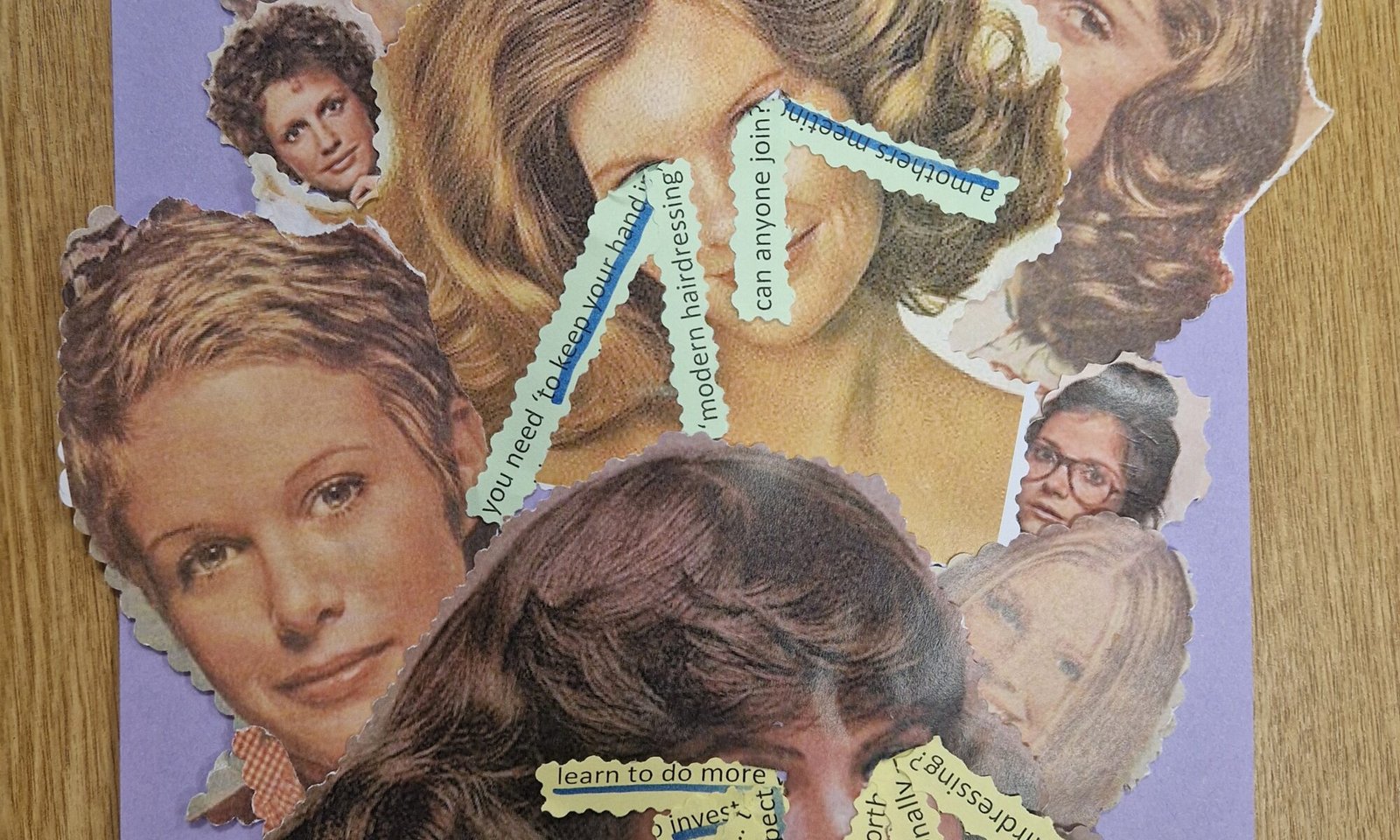
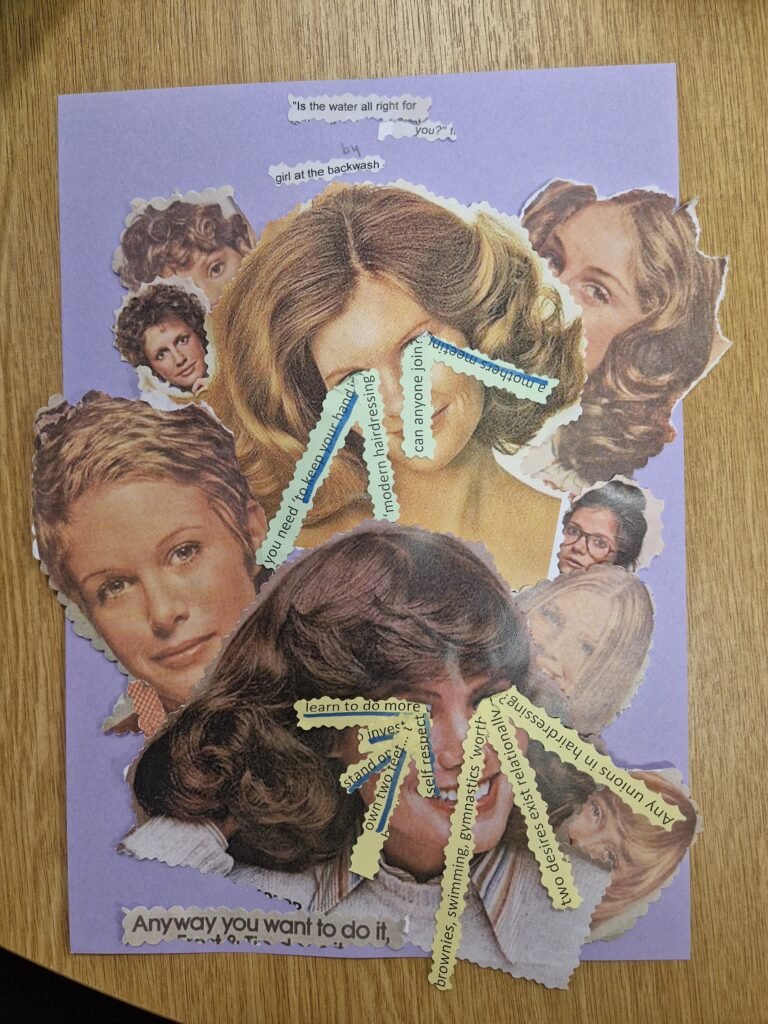
Another common thread raised during the workshop was a sense of performing, and an awareness of being observed. This was noted by several participants who acknowledged comments in the interview such as the notion of being ‘on display’ as a woman, feeling a need to look presentable for the salon, not wanting to be perceived as ‘lazy’, and interpreting the hairdressers words as a performance of independence, happiness and choice. One collage named “’Is the water all right for you?’ by Girl at the backwash” focused heavily on being observed and observing others in return. It features many faces staring back at you, some with phrases such as “modern hairdressing” and “you need to keep your hand in” spilling out of the eyes to capture the feeling of being on display. 

This was a feeling mentioned by many in the group and so I began to wonder who the women in the interview might have felt they are performing for and being observed by; it could be the pressures of maintaining a certain image in an appearance-focussed working environment, or it could be the interviewer, Sue, who asks many personal questions about being working mothers, or it might be more of a reflection of society at the time and how they feel the judgement of others in wider society. I would imagine all three play a role.

Being observed was another element that was raised when discussing participant’s own hair: our hair tells a story, it is an embodiment of our personality and communicates a lot to others. We also make assumptions about people depending on their hair- something which is so well-established that one third of the prompts given to the respondents of the Mass Observation Archive on hair referenced judging others on their hairstyle and colour. I would suggest that hair could be considered a tool for social communication, and therefore it might be inevitable that an awareness of being observed would arise from this topic.

Contrasts and Contradictions

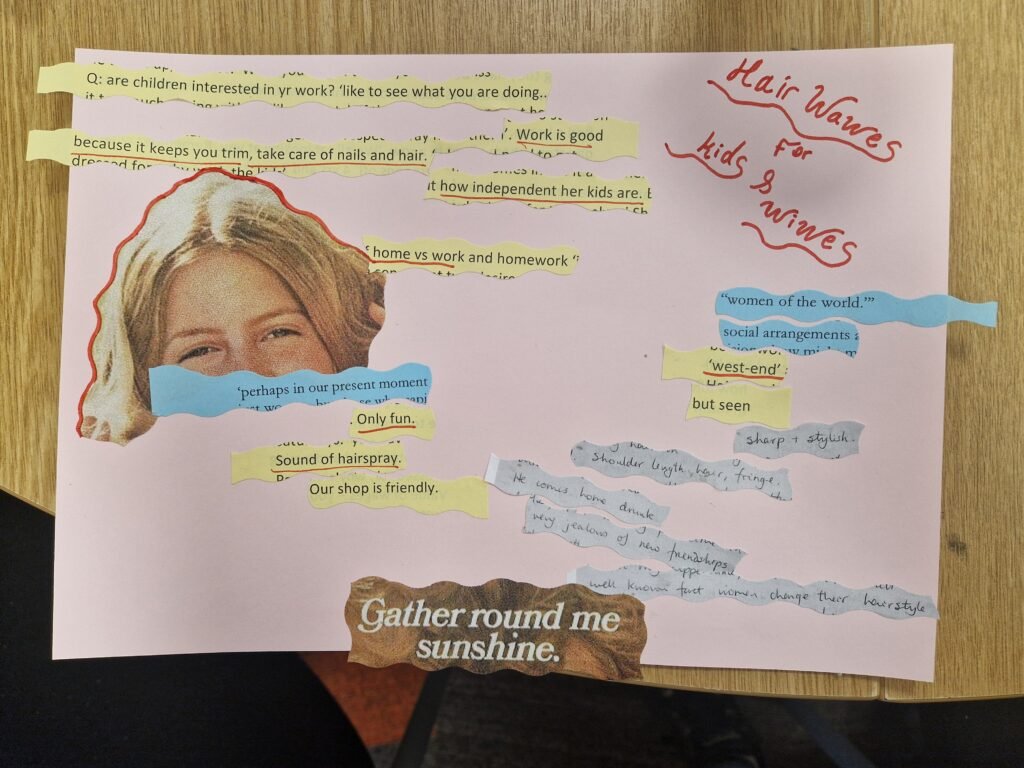
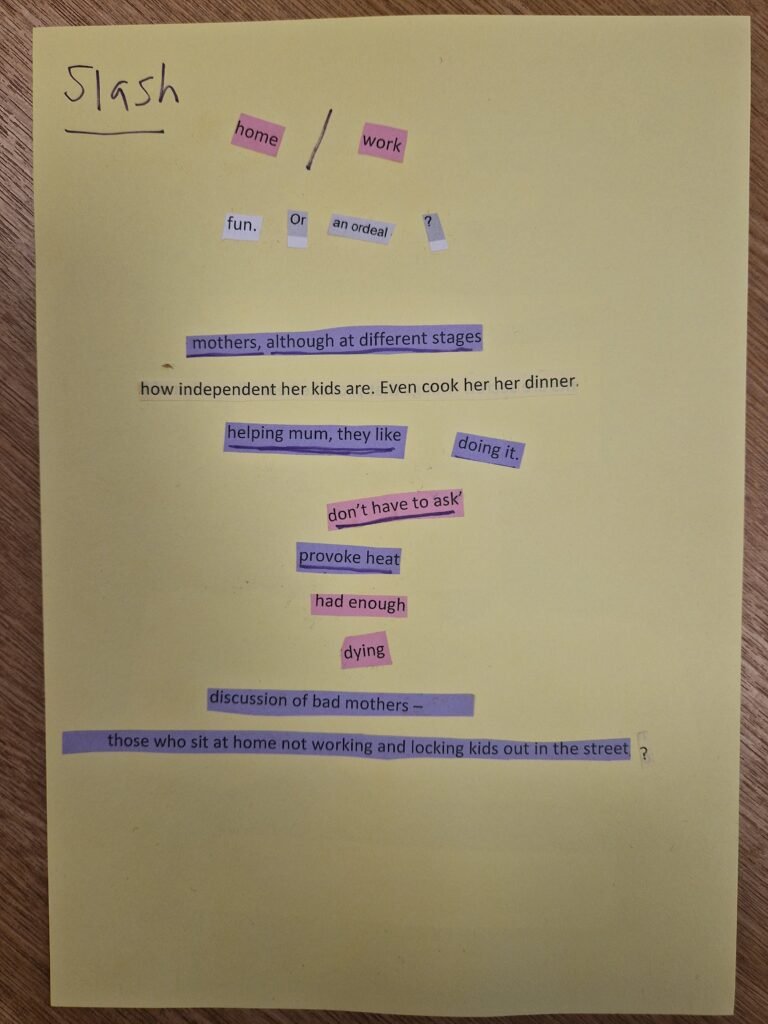
Contrasting opinions, feelings and experiences ran through this session from the start, as I described earlier in terms of the ice-breaker. But many of the collages seemed to also capture the feeling of contrasts or multiple opinions at once. One collage titled “Hair waves for kids and wives” voiced what the children’s experiences of the salon might have been in contrast to their mothers’. The creator mentioned the ‘precarity of hairdressing versus the optimism of childhood’. Another collage titled “Slash” questioned whether the hairdressers’ situations in relation to home/work were ‘fun or an ordeal’. In general the group seemed to be picking up on some contradictions in what the hairdressers were saying in the ways they were portraying their experiences – with the biggest surprise being that despite hair being the focal point of their work, at no point did they mention hair. The focus on contrasts and contradictions may have also been a reflection of a group awareness of the variety of experiences in the room or even a reflection of the varied tone and content in the materials we gave them to work with.

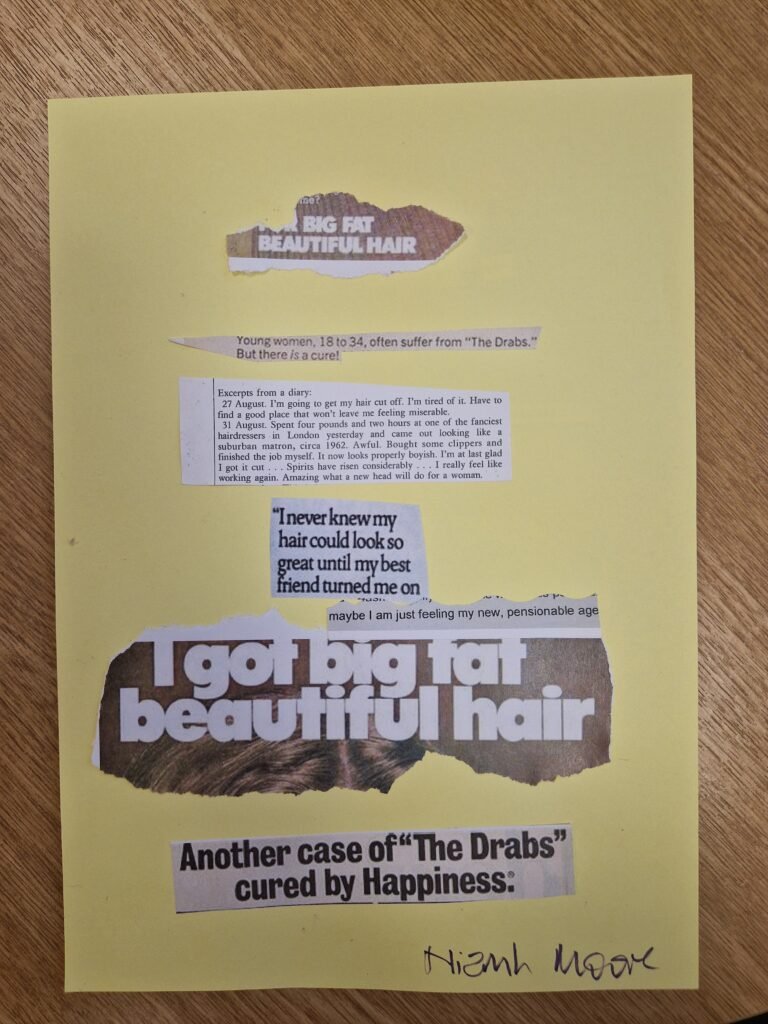
One further contradiction came in the form of subverting the expectations of beauty as projected by the 1970’s Clairol adverts, as one member of the group declared that short and clippered hair can be “big fat and beautiful”.

Trust and Intimacy

Notions of intimacy and trust between the hairdressers themselves were acknowledged by the group in terms of the women helping each other through tough circumstances, and banding together in the face of adversity and hardship: one participant became interested in when the “I’s” turned into “we’s” in the hairdressers’ stories.

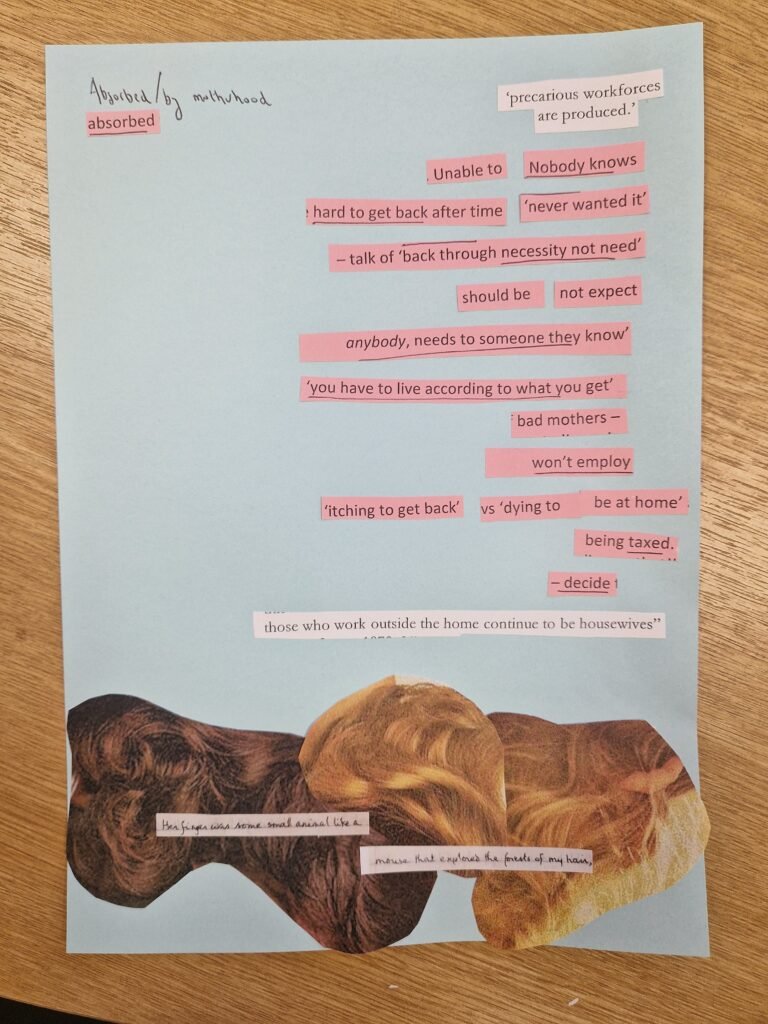
But hair can be a personally intimate topic and this was noted in the group’s discussions. One collage titled “Absorbed” centred on motherhood and the memories held in hair and touch. It is clear from the Mass Observation Archive alone that mothers are generally and historically the primary carers for children’s hair, until they reach an age at which they wish to outsource the job to a professional. Once we start outsourcing this very intimate job to someone outside of the family, we look for someone we can trust. 

This was mentioned in the context of finding and holding onto a hairdresser for life or feeling lost when a beloved hairdresser moves or retires. Several participants explained that they would go without a haircut, or would cut their own hair rather than trying a new hairdresser, to the point that one participant had almost forgotten other hairdressers existed! 
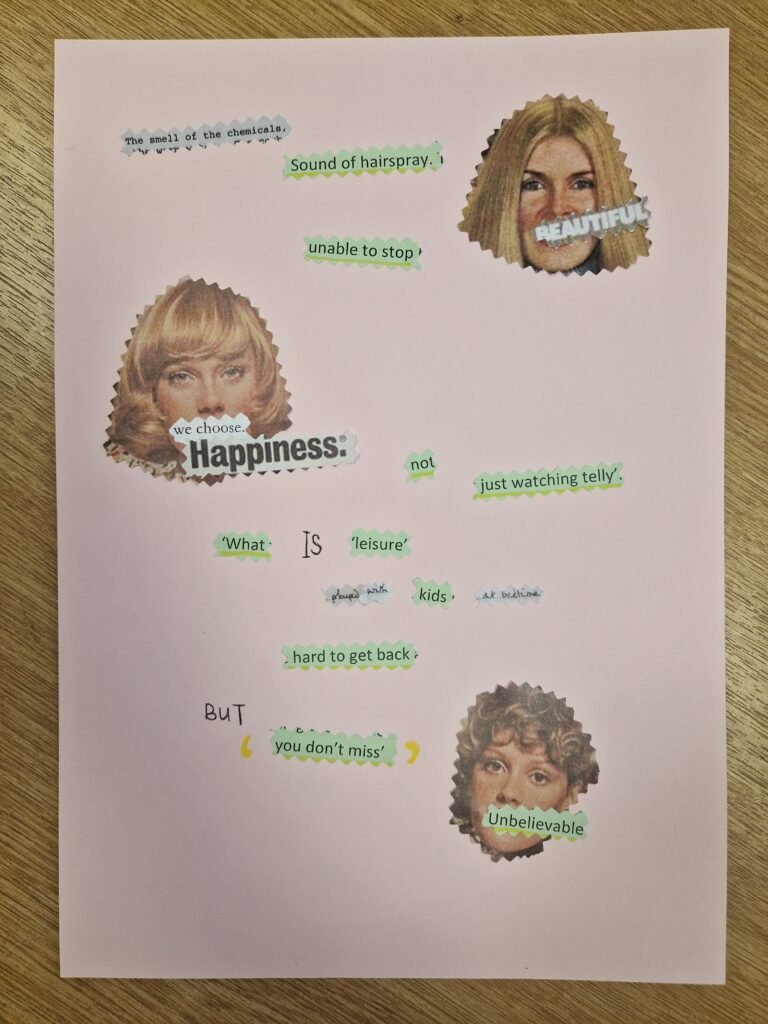
This was my first experience of a reanimating workshop, and when looking back at the day I have found myself thinking about the ‘time bind’ (Freeman, 2010). Participants were several steps removed from the women in the 1979 interview since they did not hear or read the hairdressers own words, but instead accessed their stories via Rachel’s summary of the interview. Despite this, participants seemed to pick up on things which Rachel and I had not, and still seemed able to find some deeper insight into the experiences of these women who are so far removed from them, which seemed to me to end up being (however conscious or subconscious) reflected in their own experiences of hair. 

Maybe it is the psychologist in me but everything about this process feels like it could (and maybe should?!) be a form of therapy. By connecting with the experiences of people in archived material, the time bind gives us the space to process our own feelings from a distance, whilst empathising with those we can’t and never will know. In my opinion, we can never truly know the reality of the past, since we construct it through our own perspective based on our present-day experiences. However, this very fact means that this method provides us with incredibly rich insight into experiences of the present. The beauty of this topic is that hair, being so integral to our identity, means that everyone has an emotional connection to it. However, I am endlessly curious about how the contemporary hairdressers will approach this same material and what we might learn about the present and future from their interpretations.

Freeman E (2010) Time Binds: Queer Temporalities, Queer Histories. Durham, NC: Duke University Press.

Tiny little gestures

Rachel Thomson

Just back from Leicester University on the hottest day of the year where we held an event on ‘Making & Using Sociological Archives’ supported by the British Sociological Association’s early career network fund. I was lucky to work with Laura Fenton and John Goodwin to shape the event – which brought together great speakers and included two hands-on workshops, one from the Mass Observation and Archive and one by the RAD team. Preparing for the event I knew that I had just 1 hour. Influenced by reading Hannah Charnock’s (2025) Teenage Intimacies and her interest in the gestures and practice of the erotic life of youth, I thought why not gather together material on Dancing for this exercise in data sharing and secondary analysis? A few word searches later I had enough material – a diverse set of extracts from data capturing different experiences and levels of maturity as well as capturing the moment of 1989.

DANCING EXTRACTS from FAYS archive

At first you think he’s quiet but once he gets going he’s actually quite … not wild, but he’s very outgoing. You know, he likes clubs and things and he doesn’t mind dancing on the dancefloor on his own, sort of thing but he doesn’t look like that when you look at him. Fatima 20-1, British Turkish, mc 1989

A. I’d known him for a couple of years, for the same time I’d known my boyfriend, and I was ever so close to him, such good friends; like I’d tell him everything if I was having problems with my boyfriend, he’d tell me about his life and that, and we were always close, we mucked about and whenever we went out together, us two’d slide off and have chats and laugh and joke. And one night we had a party, we both had a little bit to drink; we weren’t absolutely out of our heads, just very very relaxed, and he started to – it – it just sort of happened, he started to stroke my arms and we were dancing, and then we all stayed at this person’s house, and it just carried on. He started to kiss me when everyone had gone to sleep, and we just went outside and it happened. It was like really – it just happened. It wasn’t like planned or anything. Claire LJH40 18, white British, lm 1989

No, but in his own way he’s got looks. And at the disco on Saturday there were all the girls staring at me, no not at me, at him, well they were looking at me because I was going out with him right, and I goes “why you …and so aren’t you going to do something like go and chat them up or something”, because some boys do do that, and he goes to me “look there is only one girl I’m going out with, and the only girl I’m going out with is you”, and he goes and “you’re not moving and I’m not moving”. So I said “alright then”, and he goes “what are you looking at” and they are all looking at me and giving me dirty looks and I’m giving them a smile and he goes, “the only girl I want to go out with is you and no one else”, and he is quite good looking. Rachel LSFS1213 16 white wc

A: – Well, it affects your brain, you feel completely different in, you know like, like if you dance or something you can’t feel – like say if I ran down the road now, I’d get to the end of the road and I’d be puffed, you know, I’d be going (gasp), my legs might hurt or something, I could feel all my bags, but when you’re like on an E you an’t feel the – your heavy bags, and you can’t – so you could run like – that’s – that’s why it’s associated with the dancing, ‘cos you could dance all night and not feel it until the next morning when your muscles are killing [..] like they say the music’s got nothing to do with the drugs, but it has; the drugs and the music, the rave music, like even some of it’s in the charts, makes your heart wanna go – you know, your heart goes at the same speed as the music so that’s why you really really enjoy it Lucy LSFS36 18-19 wc 1989


it was just a trip one night into the gay strip cos it was all like on the one street and it was quite sort of spectacular and exciting compared with, sort of, life in the suburbs. And a bloke at school … cos I sort of had a girlfriend at school at the time and he, you know … he was an enemy of mine at the time and he’d been watching me, you know, with this woman and he saw that we were getting quite close and then at school camp we sort of came out together in a little tiny gesture and we were dancing together at the school dance and things like that. We got loads of flack and ridicule and he came over to me, sort of on the quiet, and sort of said, you know, ‘Come out with me one night’. So he took me and this girl out in his car and we drove away and he showed me the gay bars and I never looked back from there. I think I went every night after that – it was just brilliant!
Justine LJH7 20-21, Australian, mc 1989


I was dancing with my friends the girls, I mean I don’t particularly need anyone to dance with me, I was dancing away. I was Acid dancing; I don’t like Acid dancing music! I cringe if it comes on the radio or the television, I cringe. My mum loves it. And I was Acid dancing, I think I was, if there’d have been a competition, I’d have won. I was doing the lot. And at the end of the night, this, I think he was Arabian or Asian, man, and when I say ‘man’, I say 40-45, like my dad’s age, he just grabbed me. And swinging me around, I’ve got my chin on his
shoulder.. And this lad that, this lad had been smiling at me all night, and I’d been smiling back…. dancing away and he’s smiling again. And I wasn’t having no go with this lad. I mean it just didn’t click with me what he was actually smiling at me for, because it never entered my head, anything like that. It didn’t click with me that he’d actually like to, you know, treat me as a come-on! It was a come-on what he was doing now…dancing away. So this lad’s got me in a grip like this, this fella. And this lad’s sat down, just next to the dance floor, and he says – Come here, come here. I couldn’t hear him. I said – Excuse me? I disentangled myself, you know. And I went, he said – Sit down here and wait until that fella’s gone. What for? He said – Do you want to dance with him? I said – No, you’re alright. He goes – Alright. And when this fella had gone, he said – Right, would you dance? I’ve been smiling at you for nearly two hours and you’ve not asked me to dance. I said – Why would I ask you to dance? He said – Haven’t you heard of women’s lib? I said – No, I don’t believe in that. EDD135 Michelle, white British wc 20.


It did not take me long to gather together some images from the pages of City Life (one of the other archives consulted to complement the WRAP data). Armed with coloured paper, glue and scissors I sincerely hoped that I would be able to deliver a meaningful yet speedy workshop with the help of Kate Watson and Niamh Moore. The first 10 minutes were dedicated to the approach. Then participants sitting together at tables were invited to create their own collages using data extracts and images shared. As ever, the workshop helped us understand the method and I wanted to use this blog to capture some of the learning:

Dancing as a topic was a breath of fresh air. Approaching the data side on – rather than through the focal themes of sexuality, sexual health and power in relationships allowed us to be playful and to see the original young women at play. It also encouraged us to see the what the space of the dance floor might have meant to these young women in 1989 – a space of erotic possibility and excitement. A space of display and of being watched and watching other. But also a dynamic and contingent space where norms move quickly or where we need to find those other dance floors that might be more welcoming and fulfilling.

Tearing data: We found we didn’t have enough pairs of scissors. The group all needed the scissors at the same time so some participants resorted to tearing their transcripts to capture their chosen words and phrases. One who had previously taken part in a similar RAD workshop explained that tearing the transcript made her feel more involved and connected to the material. It seems that breaking the wall of formality around ‘data’ is essential for this method. Whether that involves throwing pages of data into the air or tearing, re-voicing or rearranging – some kind of physical entanglement with the words of others brings liveliness to the process. Another participants reflected that she underlined and cut out words that captured the tone of the data extract. Yet when she rearranged these on the page she began to also tell her own story. This is something we see happening often with reanimating practice.


The time bind is something that we explain during the introduction to the workshop, but which came alive in our discussions. The time bind is a felt connection with the material. We don’t know what that will be in advance. It is almost as if the research questions only emerge in the encounters that are staged between data and participants and that these may be diverse and personal. For example, for one of the participants this day, the date 1989 could only mean the Tiannamen Square demonstrations and he worked with words cut from the text to write a poem to connect his feelings about this historical juncture.

For another participant it was the name ’Fatima’ that drew her to the material and the idea that she could have so easily known this young women, arriving in Manchester the following year. Perhaps they moved together on the dancefloor. Her collage spoke of a longing for a friendship missed – using contextual material yet none of Fatima’s words.


Titles: As part of the workshop we ask people to name their collages. We have found this to be a valuable stage in the process of collaborative analysis as participants reflect on and condense meaning for what has been an exploratory – and often rather hurried – process. In this collage a word is taken from the text used, yet in doing so sensitises us to something particular – the sensation of being synchronised or at the ‘same speed’ as others – a prerequisite for intimacy and for dancing together.

The title ‘Slide off’ also sensitises us to the embodied and relational dimensions of romantic and erotic interaction – as the young couple ‘slide off’ the dance floor to find somewhere quiet to be together. Something that both chimes and undermines the loud and brash.


The title ‘Hip Joints’ appears to play with the language of the popular culture (with certain club nights characterised as hip joints rather then ‘hoover halls’) while also directing our eyes and minds to the literal hip joints of dancers and exercisers as they move their bodies. I can’t help thinking about how those dancing with ecstasy in 1989 may well be suffering for sore hips joints in 2025.

It is interesting to look at the collages together and to ask what they tell us as a body of material. We might focus on the specificity of the participants – for example ‘the work produced by a group of academic researchers interested in active methods’. Looking at this selection I was interested in how queer dimensions of the archive were amplified in the re-use with several picking up in the idea of coming out.

I was also struck by questions about how and where the erotic potentialities of the dance floor have moved within youth culture if the dance floor is not long what it was. We spoke in the room about where it might have gone – online, into fan cultures, gaming intimacies, sports, gym culture…?

I am also struck by how the WRAP project was itself an intervention into a culture where doing/being rather than saying /explaining was the norm. As a feminist sexual health project the study incited a ‘speaking out about sex’ that was part of a wider belief in talking that can be see in the advice of agony aunts and health educators (Gahnstrom et al. 2024) Could sex education do a better job of engaging with the gesture, the euphemism, the look-taking seriously the non verbal dimensions of sexual cultures? But should we draw our attention back to the potentialities of the dancefloor – could these be reanimated. What would that look like and whose work would it be?


References
* Gahnstrom, R., Robinson, L., & Thomson, R. (2024) Is sex good for you?, reward, and responsibility for young women in the late 1980s’ in Froom, H., Loughran, T., Mahoney, K, & Payling, D. (eds) Everyday Health, Embodiment, and Selfhood since 1950. Manchester University Press.


* Charnock, H. (2025) Teenage Intimacies: Young Women, Sex and Social Life in England 1950-80. Manchester University Press.